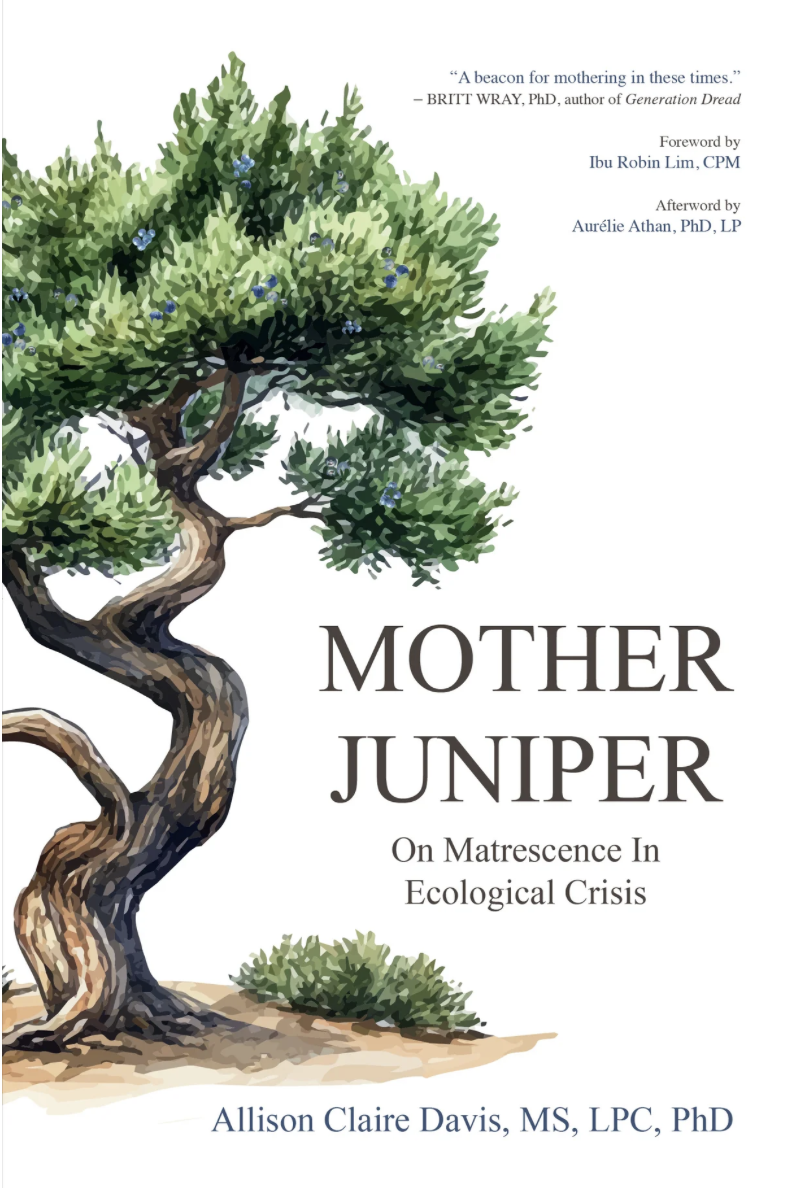
Mother Juniper: On Matrescence in Ecological Crisis
Through memoir, research, maternal psychology, and ecological encounter, Mother Juniper names maternal ecodistress and follows the developmental path that can grow through it.
9th House Press, November 4, 2026
What happens when a woman becomes a mother during the slow emergency of our ecological crisis?
I was nursing my daughter when I read the IPCC report: twelve years to limit catastrophic warming, less than the length of her childhood. My body made milk while I realized her future had a deadline. Behind my house stood a juniper — twisted, scarred, and magnificent. Over years of returning to her, I learned how her growth in hostile terrain made ground for what came after.
Mother Juniper names maternal ecodistress and traces a developmental path through it, arguing that the wound severing mothers from Earth is the wound at the root of our ecological crisis.
Mother Juniper offers...

a name
for what mothers are carrying in relationship to the natural world — maternal ecodistress — instead of mistaking it for mental illness or personal failure

a path
seven chapters of development, drawn from clinical practice and original research, tracing how that distress can be metabolized rather than simply carried

and repair
a developmental path back to a bond with the living world — one a mother can root in herself, modeling the very belonging she hopes her children will grow into
Inside the Book
Mother Juniper follows the juniper tree's seven pioneer species functions as a developmental path mothers can walk through ecological crisis.
Chapter 1: The Landscape — Detecting What's True
A juniper survives by detecting what's true: the lead in her rings, the drought years written into her growth. Before any transformation is possible, there must be accurate perception — of the world, and of what mothers are carrying that has no name yet.
Chapter 2: The Roots — Stabilizing Ground
A juniper's roots spread twice as wide as her canopy, holding ground that would otherwise erode. Stabilization is what lets a mother reach toward her own depth — restoring a relationship between body and Earth that the culture severed, and is still severing.
Chapter 3: The Trunk — Metabolizing What We Carry
What a tree absorbs has to go somewhere; her trunk turns it into growth. This chapter traces what it means for a mother to metabolize what she carries, rather than simply holding it, and the Earth-Self that begins to mature in the process.
Chapter 4: The Branches — Extending Outward
Branches read their environment, reaching toward light, thickening where wind demands strength. Extension is what happens when a rooted body reaches into new conditions and makes them livable — and what happens to ecological care when it has no root system to extend from.
Chapter 5: The Canopy — Sheltering Together
Where enough trees grow close, their separate shelters connect into continuous canopy. This chapter moves from individual healing into shelter built in common — grief held together, ritual made for losses the culture has no ceremony for.
Chapter 6: The Fruit — Nourishing What Needs to Survive
A juniper produces fruit only once she is healthy enough to give beyond her own survival. This chapter asks what it means for a mother to nourish what needs her — including a self that has been going hungry — without that nourishment costing her everything.
Chapter 7: The Seeds — Transmitting the Template
A juniper releases her seeds into relationships she can't control, carried by birds and coyotes into soil she will never touch. The closing chapter traces what mothers actually pass forward: the capacity to repair, carried in how they live rather than handed down whole.
Mother Juniper opens with a foreword by Ibu Robin Lim and closes with the Conclusion: A Pioneer Species Inquiry, drawing all seven functions into a single arc, followed by an afterword by Aurélie Athan.
A Note from the Author
"Motherhood is not merely the raising of children. It is the emergence of a new ecological identity out of maternal ecodistress."


Advance Praise for Mother Juniper
“Allison Davis has done something remarkable with Mother Juniper: she named maternal ecodistress with the precision of a clinician, the courage of a mother, and the grounded wisdom of someone who has genuinely learned from the living world, opening a new domain of care that climate psychology has long needed someone to pioneer. For anyone who has felt the impossible weight of loving a child fiercely while grieving the planet they will inherit, this book is both a salve and a revelation, weaving nature connection, attachment science, and lived matrescence into a framework that finally holds the whole truth of what we are carrying. A beacon for mothering in these times.”
“Until now, psychology, psychiatry, and modern medicine in general have had no container for the strife of mothers struggling to nurture and nourish their children in the era of ecological crisis. Allie Davis has written the book and done the research that assures me I am not alone. You have named our Maternal Eco-Trauma. Maybe in baby steps, we can heal it enough to survive, perhaps to thrive.”
“I have never before seen such a deep understanding of how the transition to motherhood has become both a precipice for severe climate distress, and an opportunity, if properly supported, for the development of a strong and centered Ecological Selfhood. Allison skillfully weaves her own story and the power found in her secure attachment to Mother Juniper, with wisdom born from years of witnessing and guiding other mamas to a place of wholeness from which we are prepared to face our children's futures. This book is a must-read for all professionals in the perinatal fields, and a wonderful resource for any mother who has believed herself alone on this journey. I only wish it had been available when my child was born.”
“Mother Juniper gives us a long-needed revision of attach-ment theory that is intended to match the realistic experience of eco-distress with ecological care work. The worldview presented is the therapeutic reframing that women have been crying for and need immediately. Allison Davis grounds us in a vision of how to nourish matrescence and thereby meet the true needs of children. A weave of memoir, practical nature-based guidance, and overview of feminist and ecospychology research, the framework Davis provides is a service to everyone, especially young and future mothers.”
"If you’ve ever found yourself deeply responsible for the survival and wellbeing of another living being, you need to read this book! And if you or a friend are going through the profound rite of passage of becoming a mother in a time of ecological crisis, author Allison Davis offers an essential guide to the transformative psychological transition that happens as “the self becomes a mother.” Maternal ecodistress and the Earth-Mother wound are increasingly urgent issues as we all struggle to survive and thrive in worsening circumstances. Davis reminds us that “What mothers are experiencing in the slow emergency matters beyond mothers themselves. The capacity for ecological consciousness travels through the attachment system, activated by the work of tending new life."
